ISISLab

“A survey on open-source collaboration platforms” di Tiziano Citro

Abstract:Collaboration platforms empower teams to discuss, brainstorm and work together with immediate feedback regardless of location. The purpose of collaboration platforms is to integrate social networking capabilities into work processes, which can help raise productivity. We will present a survey on open-source modern collaboration platforms, discuss which one we picked among them and why, and […]
“Developing Educational Games via a Cloud Solution” di Antonio De Caro

Aula P6 (Edificio F3) - Dipartimento Informatica, Via Giovanni Paolo II, 132, 84084 Fisciano SA

Abstract: Cloud computing is a current trend in information technology and has become an important part of many industries. In the educational games field, cloud computing has the potential to revolutionize how educational games are created, delivered, and consumed.This research aims to contribute to a better understanding of how cloud computing can be integrated into […]

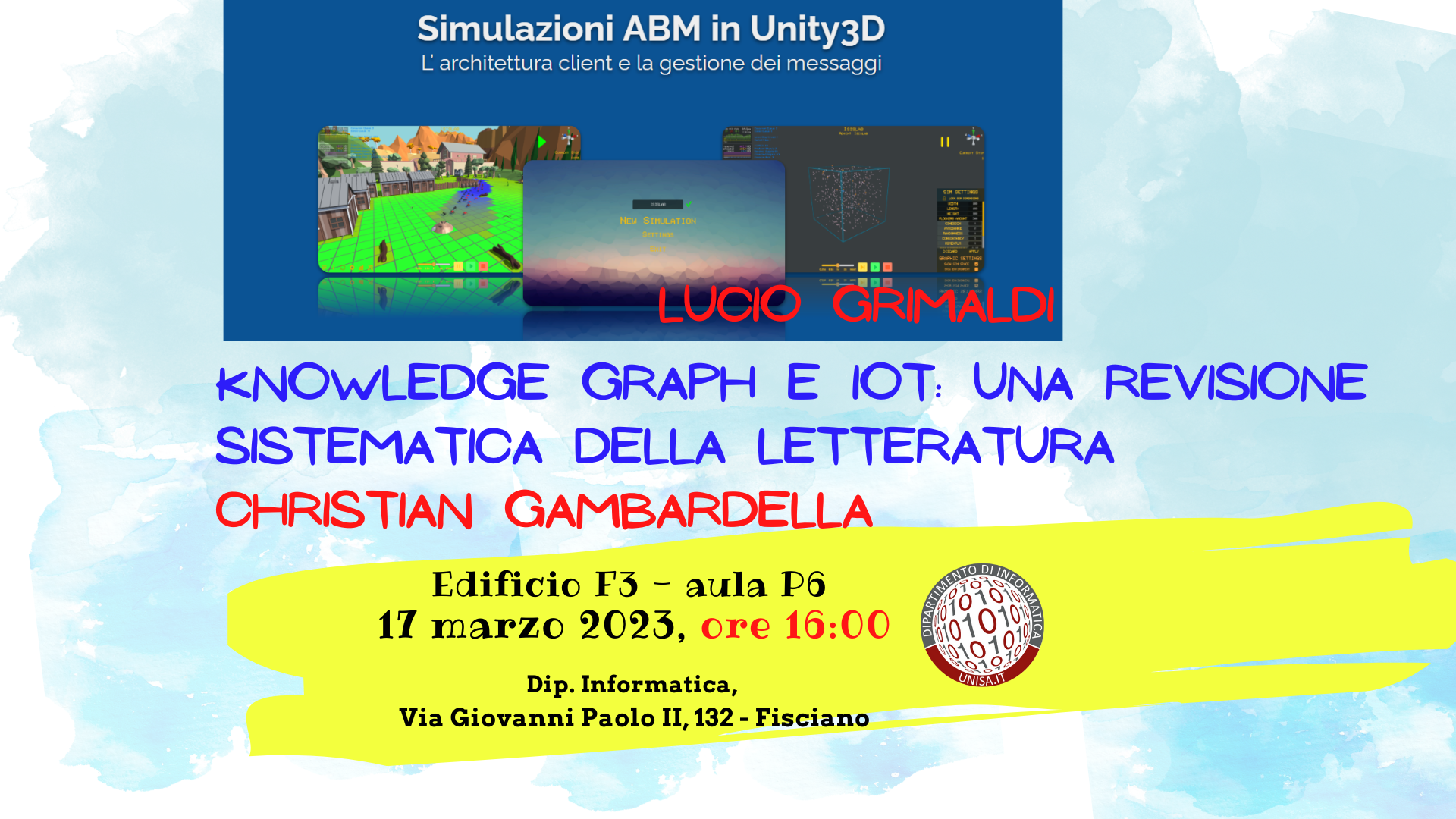
Seminario: “Knowledge Graph e IoT: una revisione sistematica della letteratura” di Christian Gambardella

Abstract: "Un Knowledge Graph rappresenta una rete di entità del mondo reale, come oggetti, eventi, situazioni o concetti, e illustra le relazioni tra di esse.Queste informazioni vengono di solito immagazzinate, come suggerisce il nome, in una base di dati a grafo e poi visualizzate nella medesima forma.Questa tecnologia, annoverata tra le cosiddette Semantic Web Technology, […]

Seminario: “Cyber Threat Intelligence e Blockchain: studio, analisi e possibili sviluppi” di Antonio Donnarumma e Mario Offertucci

Abstract:Con il progredire dell'industria 4.0, l'utilizzo di dispositivi intelligenti è diventato sempre più frequente. Nonostante i numerosi vantaggi derivanti da essi, questi costituiscono, spesso, un nuovo vettore d'attacco per gruppi organizzati.Nascono quindi le prime piattaforme di condivisione degli attacchi subiti, con lo scopo di creare un database distribuito che permette di sopperire alle vulnerabilità a […]

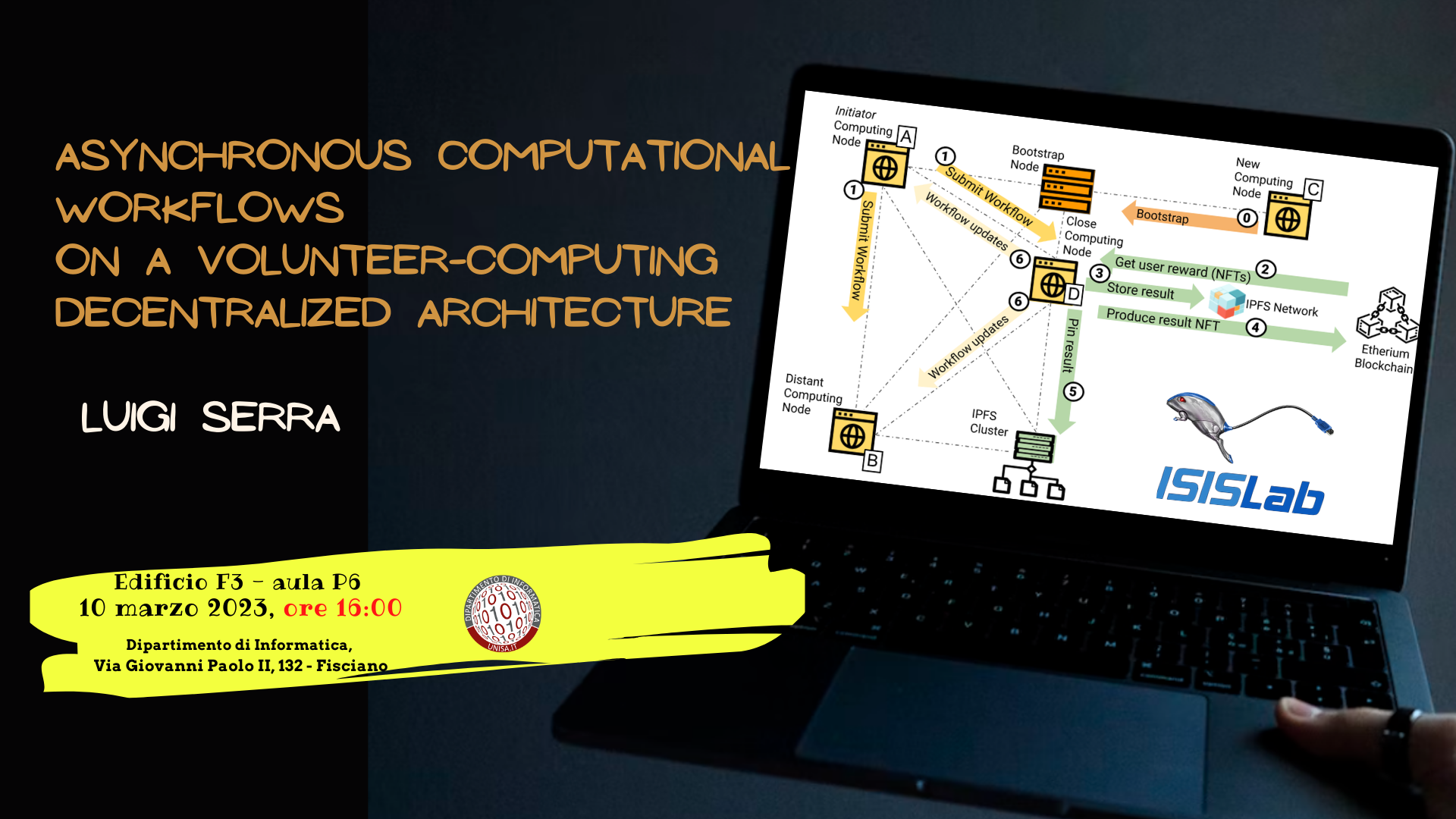
Seminario: “Asynchronous Computational Workflows on a Volunteer-Computing Decentralized Architecture” di Luigi Serra

Abstract:The amount of accessible computational devices over the Internet offers an enormous but latent computational power. Nonetheless, the complexity of orchestrating and managing such devicesrequires dedicated architectures and tools and hinders the exploitation of this vast processing capacity. Over the last years, the paradigm of (Browser-based) Volunteer Computing emerged as a unique approach to harnessing […]

Seminari di Lucio Grimaldi e Christian Gambadella

"Simulazioni ABM in Unity3D: l’architettura del client e la gestione dei messaggi" di Lucio Grimaldi Abstract : Il panorama delle simulazioni è in grado di dare un grande apporto allo studio dei fenomeni reali. I modelli computazionali studiati per simularli, sono in grado di aumentare la conoscenza che abbiamo del mondo che ci circonda. I […]

Seminario: “Combining Agent-based Model and Discrete Event Simulation: the approach of Hybrid Simulation Modeling” di Giuseppe D’Ambrosio

Abstract: Agent-Based Modeling (ABM) and Discrete Event Simulation (DES) are two of the most common simulation approaches, and are supported by many simulation tools. Recently, modelers have begun integrating these methods to simulate real-world situations which have some elements better represented by DES and others better represented by ABM. Hybrid ABM and DES simulation is […]

Hyperlinking Object-Oriented Discussion: A New Approach To Collaboration di Tiziano Citro

Abstract:Modern collaboration platforms have familiarized users with the benefits and capabilities of real-time communication. However, real-time communication can also introduce challenges in the form of a lack of context and limited control over discussed data. To address these issues, this work proposes a new collaborative approach called Hyperlinking Object-Oriented Discussion (HOOD), where discussed data is […]